
In short: MacAdam steps (or SDCM) indicate how much the colour of light emitted by LEDs that are nominally identical can vary from one source to another. The lower the number, the more consistent the light. Up to 3 steps, the human eye will barely detect any difference. From 5 steps upwards, differences become visible, particularly when sources sit side by side, as they do in a continuous line of light.
Same white, but not quite the same
Think of two tins of white paint, same brand and same colour code, bought at different times. The labels are identical. But paint two adjacent walls, one from each tin, and you may notice that one looks slightly warmer and the other slightly cooler.
LED light behaves in exactly the same way.
When specifying an LED source, we almost always state its correlated colour temperature (CCT): 2700K for warm white, 3000K for warm-neutral, 4000K for neutral white. That is the label on the tin. Yet two LED strips both rated at 3000K can emit slightly different light: one with a faint green tint, the other faintly pink; one marginally more yellow, the other marginally whiter.
How large can that difference be? That is precisely what MacAdam steps measure.
What are MacAdam steps?
MacAdam steps take their name from David MacAdam, an American scientist who, in the 1940s, investigated a deceptively simple question: how different do two colours need to be before the human eye can tell them apart?
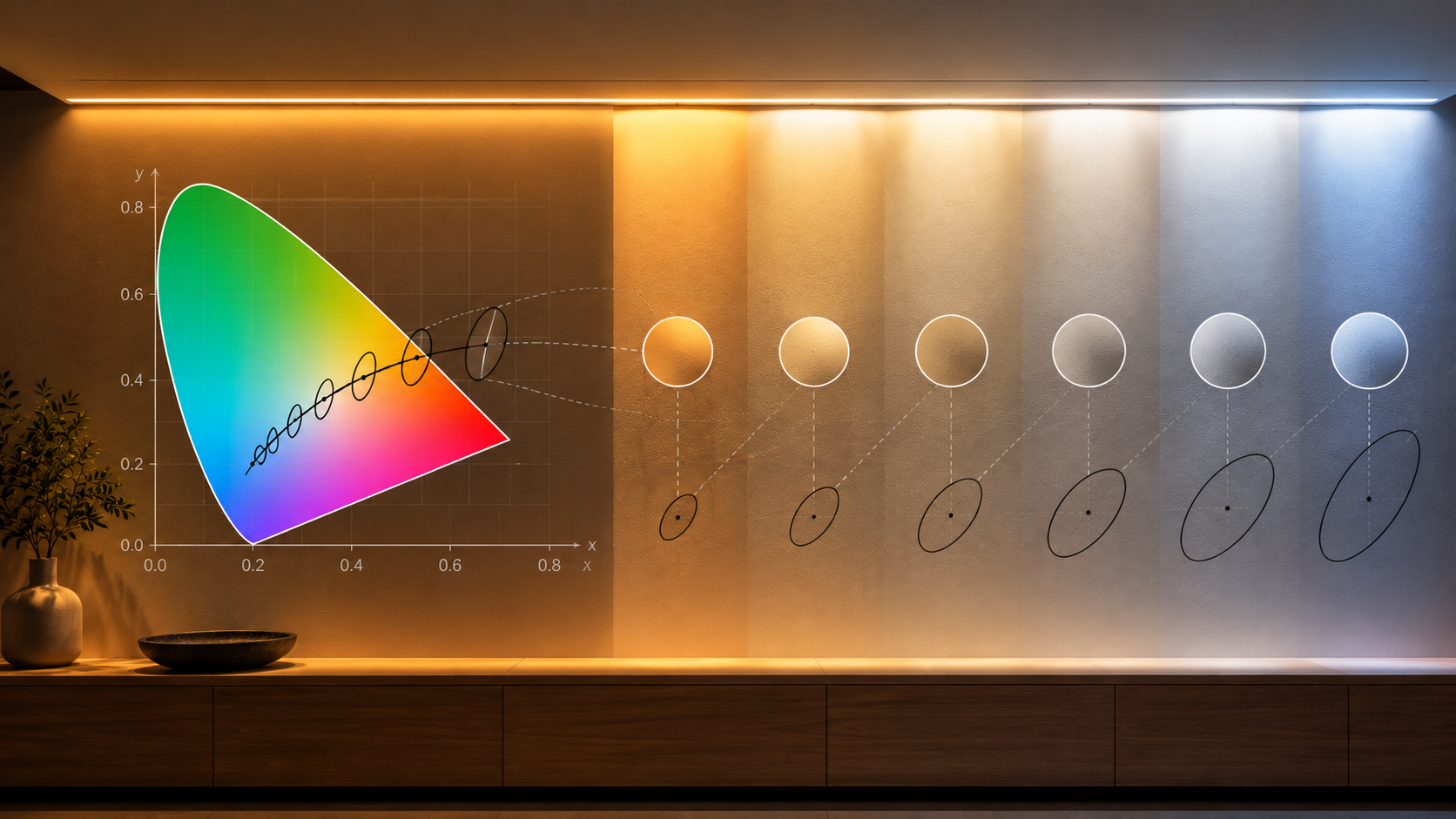
To answer it, he had an observer compare a large number of colour pairs, adjusting one until it matched the other. He found that around every colour there is a small “zone” of shades the eye cannot distinguish from the original. Plotted on the CIE chromaticity diagram, this zone takes the shape of an ellipse. Hence the name MacAdam ellipses.
The smallest ellipse corresponds to 1 step. Larger ellipses are multiples of it: 2 steps, 3 steps, 5 steps, 7 steps.
On datasheets, the same value is often given as SDCM (Standard Deviation of Colour Matching). “3-step MacAdam” and “SDCM 3” mean exactly the same thing.
How to read the number
The principle is straightforward: the number of steps indicates how far the actual chromaticity of each LED can drift from its nominal value.
– Low number (1–3 steps): all LEDs emit virtually the same colour of light.
– High number (5–7 steps): there may be visible colour differences between one LED and the next.
How much difference does the eye actually see?
A practical guide to interpreting the values you will find on datasheets:
- 1 step: no visible difference. Laboratory-grade precision.
- 2 steps: no visible difference, even with sources side by side.
- 3 steps: at the threshold of perception. Only a trained eye will notice, and only with sources in direct comparison. This is the benchmark for quality projects.
- 4–5 steps: noticeable when sources are close together.
- 6–7 steps: clearly visible. Typical of entry-level products.
Context matters too. Two luminaires 5 steps apart in different rooms will probably never be compared. Two lengths of LED strip with the same difference, running one after the other in the same cove, certainly will be, and the colour “jump” will show.
Why aren’t all LEDs identical?
It is a fair question: if LEDs are mass-produced, why aren’t they all the same?
Because no manufacturing process is perfect. Even LEDs produced on the same day, on the same line, show small variations in chromaticity, luminous flux and forward voltage. To manage this, manufacturers measure every LED and sort it into homogeneous groups. The process is called binning.
Think of it as grading fruit by size:
– select LEDs only from a very narrow group (tight binning) and you get highly consistent light, at 2 or 3 steps, but at a higher cost;
– accept LEDs from a wider range of groups (wide binning) and the product costs less, but colour consistency drops to 5, 6 or 7 steps.
That is why two LED strips with the same CCT, the same power and the same CRI can carry very different price tags: the difference often lies precisely in their colour tolerance.
What the standards say
Colour tolerance is also addressed by regulation. Two references worth knowing:
In Europe, Regulation (EU) 2019/2020 on ecodesign requirements for light sources requires LED light sources to achieve colour consistency within a 6-step MacAdam ellipse or less. This is the minimum requirement for placing an LED light source on the EU market.
In North America, ANSI C78.377 defines the chromaticity ranges for each nominal CCT using quadrangles roughly equivalent in size to a 7-step MacAdam ellipse.
The message is clear: “compliant” does not mean “consistent”. A 6-step source is perfectly legal, yet in an exposed line of light it may show obvious colour variation. Where the aesthetics of light matter, the benchmark is 3 steps or fewer.
Where colour tolerance really makes the difference
In linear LED lighting, colour tolerance is especially critical. An LED strip is made up of hundreds of small LEDs per metre, one after another. Any colour variation between one LED and the next, or between one length of strip and the following one, reads as a “patch” or a “step” in the line of light.
The most critical applications:
Long, continuous runs. In perimeter coves, ceiling slots and recessed profiles, every joint between two lengths of strip is a point of direct comparison. With a wide tolerance, the line looks “patchy”.
Light-coloured surfaces and wall washing. When light grazes a white wall or a uniform surface, colour differences become more pronounced, because the surface itself amplifies them.
Retail and showrooms. A shelf lit with a slightly greener or pinker light than the rest changes how the merchandise on it is perceived.
Hospitality and high-end residential. Where light creates the atmosphere, colour inconsistency is perceived as a quality defect, even by people who could not explain why.
Replacements over time. If a length of strip is replaced after a few years, the new one may have a slightly different colour. The tighter the specified tolerance, the less noticeable the replacement.
Does the colour of light change over time?
Yes, to some extent. Over the years, the chromaticity of LEDs can shift slightly: a phenomenon known as colour shift. The main driver is heat: an LED operating at excessive junction temperature ages faster, and its colour point drifts with it.
This is why light quality depends not just on the LED strip, but on the whole system:
– an adequate aluminium profile acts as a heat sink;
– a correctly sized driver avoids overdriving the LEDs;
– correct installation, following the manufacturer’s instructions, keeps the LEDs within their design operating conditions.
5 practical tips for specifying correctly
1. Always ask for the SDCM value. Alongside CCT and CRI, colour tolerance should be one of the parameters you check. For exposed lines of light, aim for 3 steps or fewer.
2. Be wary of datasheets that omit it. If the value is not stated, there is no guarantee of colour consistency.
3. Order all the material at once. Procuring the entire supply for a project in a single order, from the same production batch, reduces variation even further.
4. Don’t mix brands within the same run. Even with identical declared values, products from different suppliers can have slightly different colour points.
5. Keep a few metres in reserve. Retaining some material from the same batch is the simplest way to make future replacements without visible colour differences.
LEDCO’s approach to light quality
At LEDCO, we see colour consistency as an essential part of light quality, not a technical footnote at the bottom of a datasheet. We select sources, profiles and drivers with a view to how they will perform together, to deliver lines of light that are consistent from the first metre to the last.
Our technical team is on hand to advise on the colour characteristics of our products and help you choose the right solution for your project.
Frequently asked questions about MacAdam steps
What are MacAdam steps, in simple terms?
They are a unit that indicates how much the colour of light can vary between LEDs that are meant to be identical. The lower the number, the more consistent the light.
What is the difference between MacAdam steps and SDCM?
None: they are two ways of expressing the same thing. “3-step MacAdam” is equivalent to “SDCM 3”.
How many MacAdam steps should a good LED strip have?
For exposed lines of light and projects where aesthetics matter, the benchmark is 3 steps or fewer.
If two LEDs have the same colour temperature, do they emit the same light?
Not necessarily. CCT indicates the overall tone, such as warm or neutral. MacAdam steps indicate how far each individual LED can deviate from that tone.
What is the legal limit in Europe?
Regulation (EU) 2019/2020 requires colour consistency within a 6-step MacAdam ellipse or less. It is a minimum requirement: sufficient to place a product on the market, but not always enough for a high-quality aesthetic result.
Does LED colour change over time?
It can shift slightly over the years, especially if the LEDs operate at excessive temperatures. A good aluminium profile and a correctly sized driver help keep it stable.
Want consistent light from the first metre to the last?
When colour consistency matters, the choice of light source should be made with the right data.
The LEDCO technical team will help you identify the best solution for your project.