
In short: flicker is a rapid, continuous fluctuation in light output. In 220V LED strips it is often so fast that it is not perceived as visible flickering, yet it can cause visual fatigue, a stroboscopic effect and interference on video recordings. The LEDCO SLP220 anti-flicker device is installed upstream of 220V LED strips and stabilises the supply, for steady light and better visual comfort in the workplace.
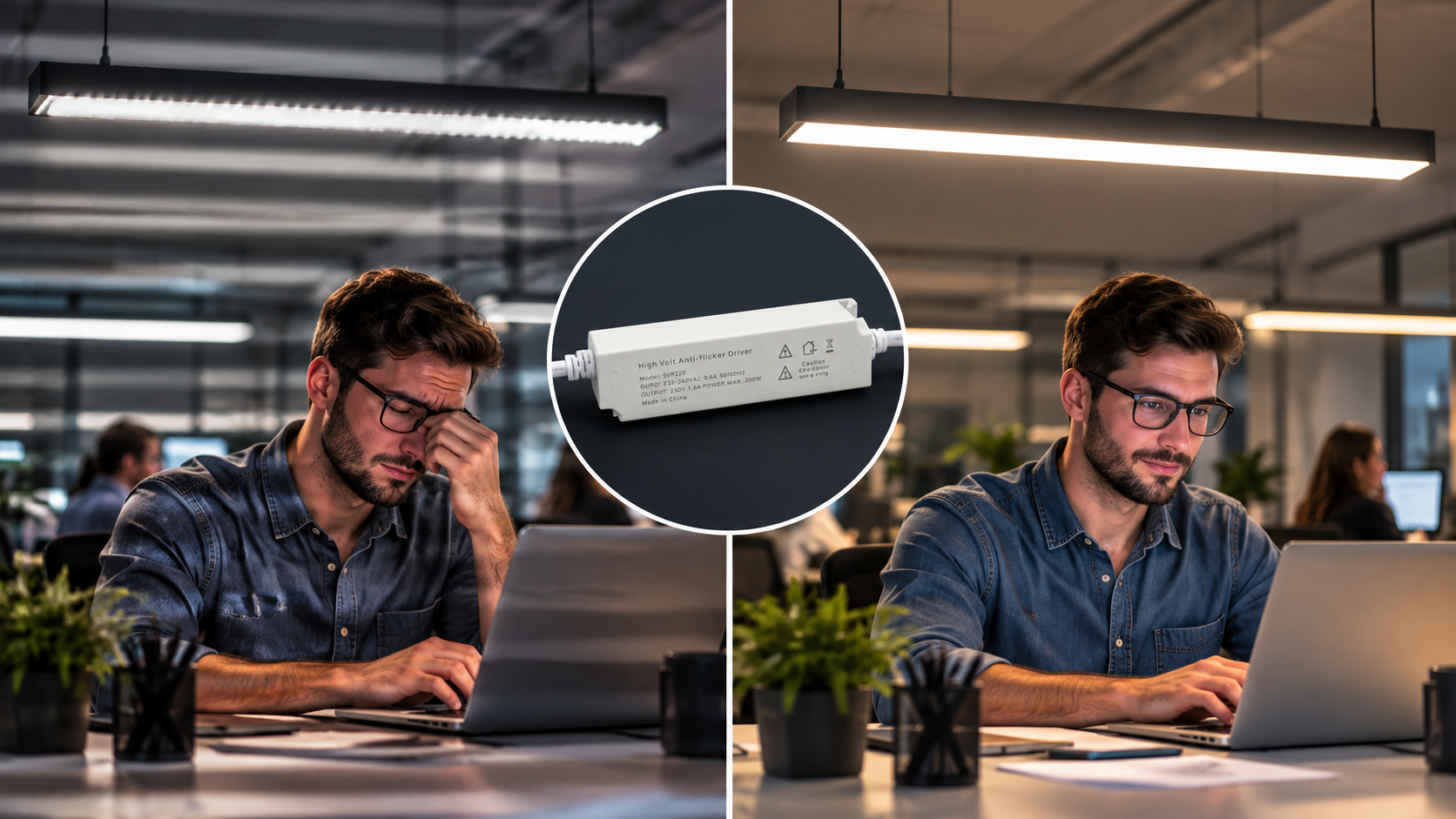
What flicker is and why it often goes unseen
Flicker is the periodic variation in the light output of a source. In practice, the light does not stay constant: it rises and falls many times a second.
When the fluctuation is slow, flicker is obvious and irritating. When it is very rapid, the eye no longer recognises it as such: the light appears steady and even. This is what is known as invisible flicker.
Why it happens with 220V LED strips
The mains supply is alternating current at 50 Hz: the voltage reverses direction fifty times a second. 220V LED strips are powered directly from mains voltage, suitably rectified. If the supply is not stabilised, the light output follows these fluctuations and “pulses” at high frequency.
The eye cannot distinguish the individual pulses, but the visual system still registers them.
Why invisible flicker is a problem in the workplace
Even when it cannot be seen, flicker can have real effects on people who spend many hours under that light, and on the equipment in the space.
Visual fatigue. The eye works constantly to adapt to the variations in light. In more sensitive people, after many hours, this can lead to eye strain, difficulty concentrating and headaches.
Stroboscopic effect. Moving objects, such as hands, tools or machine parts, can appear fragmented or jerky. In some settings it is merely a nuisance; in others it interferes with the perception of movement.
Interference on video recordings. Cameras and smartphones record at frame rates that can “catch” the flicker of the light. The result is dark bands rolling across the image, variations in brightness and unstable footage.
CCTV systems. This is one of the most common cases: security cameras installed in spaces lit by 220V LED strips can produce disrupted images, with banding and brightness variations that reduce their legibility.
Perceived quality. Steady light is part of the quality of a space. Even when nobody can identify the cause, lighting that feels tiring is perceived as less comfortable.
SLP220: the anti-flicker device for 220V LED strips
The SLP220 is the LEDCO device designed to eliminate flicker in installations using 220V LED strips.
How it works
The device is installed between the supply circuit and the 220V LED strip. Its job is to stabilise the supply reaching the strip, reducing the fluctuations responsible for flicker.
The result is steady, continuous light with no pulsing, improving visual comfort for occupants and the quality of the images recorded by cameras and video equipment.
Key features
- Input voltage: 220 Vdc
- Power output: up to 400 W
- Application: indoor
- Ingress protection: IP20
- Installation: wall or ceiling mounting
- Housing: PVC
- Power supply: not included, to be ordered separately
- Compliance: CE marking, RoHS, WEEE
With a power output of up to 400 W, a single device can also handle long runs, simplifying the installation.
How to integrate the SLP220 into your project
A few practical guidelines for designers and electrical contractors.
Plan for it from the outset. If the scheme uses 220V LED strips in workplaces or areas with cameras, it makes sense to include the anti-flicker device at design stage, alongside the choice of light sources.
Check the total load. Add up the power of the connected strips and make sure the total stays within the 400 W handled by the device. For larger installations, runs can be split across several devices.
Think about where it goes. Wall or ceiling mounting allows the device to be located in a plant space, an accessible ceiling void or a service area, out of sight.
Remember it is for indoor use. With an IP20 rating, the SLP220 must be installed in dry indoor locations.
Order the power supply. The power supply is not included and must be ordered separately.
Applications: where eliminating flicker makes the difference
Offices and corporate workplaces. People who spend long hours at a computer or desk benefit from steady light that reduces visual fatigue over the working day.
Schools, classrooms and training rooms. Spaces where attention and concentration need to stay high throughout lessons.
Medical practices and clinics. Spaces where the comfort of patients and staff is part of the quality of care.
Shops and showrooms. Steady light shows products at their best, even when customers photograph or film them on their smartphones.
Meeting rooms and video conferencing. Cameras capture a clean image, free from banding or brightness variations.
CCTV systems. The SLP220 cancels the interference that flicker from 220V LED strips can cause on security camera images, improving their legibility.
Workshops and production areas. Where people work with tools or moving parts, eliminating the stroboscopic effect improves the perception of movement.
Frequently asked questions about LED strip flicker
What is LED strip flicker?
It is a rapid, periodic variation in light output. When it is very fast, the eye does not perceive it as flickering, but it can still cause visual fatigue, a stroboscopic effect and interference on video recordings.
Why can 220V LED strips flicker?
Because they are powered from mains voltage, which oscillates 50 times a second. If the supply is not stabilised, the light follows these oscillations.
How do you eliminate flicker in 220V LED strips?
By installing an anti-flicker device such as the LEDCO SLP220 upstream of the strip: it stabilises the supply and makes the light continuous.
Does flicker affect cameras?
Yes. Cameras and smartphones can record dark bands and brightness variations. The SLP220 cancels this interference, including on CCTV systems.
What load can the SLP220 handle?
Up to 400 W output. For larger installations, several devices can be used, splitting the runs between them.
Can the SLP220 be installed outdoors?
No, it is an indoor device with an IP20 rating.
Steady light for more comfortable workplaces
With the SLP220 anti-flicker device, 220V LED strips deliver continuous light without flicker, benefiting both the people in the space and the images recorded by cameras.
→ Discover the device: SLP220 – 220V Anti-Flicker Device
→ Need help with your specification? The LEDCO technical team will help you integrate the SLP220 into your project. Contact the technical team