
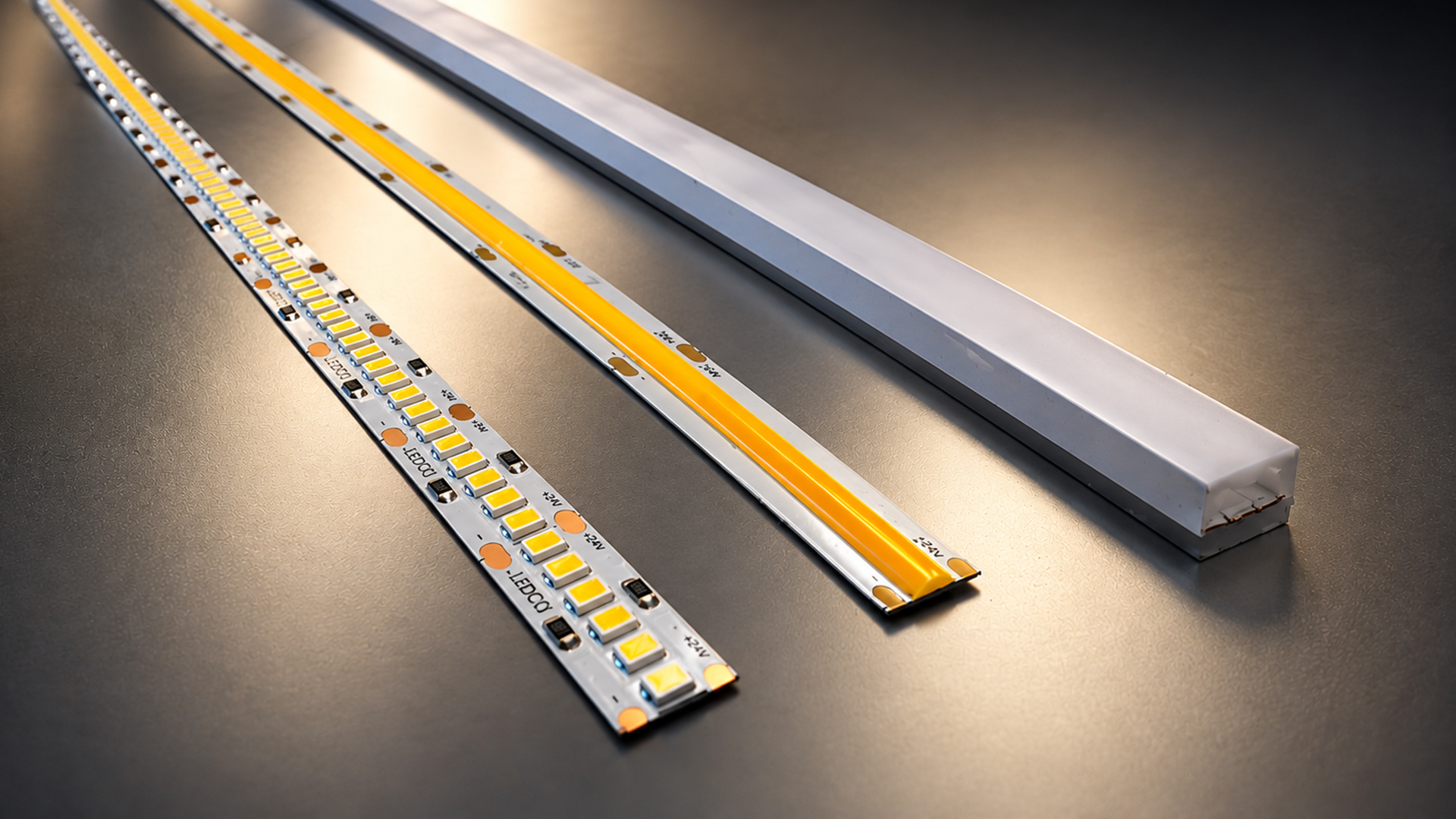
In short: SMD, COB and SOB LED strips differ in the way the LEDs are mounted on the strip, and therefore in the kind of light they produce. SMD strips use separate LEDs, clearly visible as individual points of light. COB strips mount a large number of closely spaced chips beneath a continuous layer of phosphor, creating a uniform line of light. SOB strips encapsulate the LEDs in a layer of silicone that diffuses the light and protects the strip. There is no single best technology: there is the one best suited to the project.
Why strip technology matters
Two LED strips can share the same colour temperature, the same colour rendering and the same wattage, yet produce a completely different effect once installed.
The difference lies in how the light is generated along the strip: from many separate points, or from a continuous line. It is a choice that shapes the final appearance of the light, the type of profile required, the installation depth and even the project budget.
For architects, lighting designers and electrical contractors, understanding the differences between SMD, COB and SOB means specifying the right strip from the outset, with no surprises on site.
SMD LED strips: the most widely used technology
How it is built
SMD stands for Surface Mounted Device. In an SMD strip, the LEDs are small, separate components, soldered one after another along the strip at regular intervals. Each LED is a self-contained package, with its own chip and its own phosphor.
It is the original LED strip technology and remains the most widely used today.
The light it produces
Look at an SMD strip switched on without any cover and you will clearly see the individual points of light: the so-called “dotting” effect.
This is not a flaw but a characteristic to be managed at design stage. To achieve a uniform line of light, an SMD strip should be installed in a profile with a diffuser, positioned at a certain distance from the LEDs. The deeper the profile and the more opaque the diffuser, the more the points blend into a continuous line.
When to specify it
- Indirect lighting, such as coves and coffers, where the strip is concealed and the light reaches the space by reflection off ceilings and walls.
- Profiles with diffusers of adequate depth, where the dotting effect is evened out.
- Projects with varied output and power requirements, thanks to the breadth of the available range.
- Technical and functional applications, where the quantity of light matters more than the appearance of the source.
In the LEDCO range: SL200, SL180, SL125 and SL120.
COB LED strips: the continuous line of light
How it is built
COB stands for Chip On Board. A COB strip has no separate LEDs: hundreds of very small chips are mounted directly onto the strip, closely spaced, and covered by a single continuous strip of phosphor.
With the strip switched off, the result is a thin yellow line running along its entire length.
The light it produces
Once switched on, a COB strip emits a uniform line of light with no visible dots, even when viewed directly and without a diffuser.
It is the technology that changed the way linear lighting is designed: a continuous line no longer requires deep profiles or heavily opal diffusers.
When to specify it
- Exposed lines of light, where the source is visible and must read as a continuous stroke.
- Slim, shallow profiles, where there is no room to set the strip back from the diffuser.
- Furniture and retail: shelving, niches, display cases and cabinets, where the light is close to the viewer.
- Architectural details where a “neon” effect needs to look clean and continuous.
Worth bearing in mind: the high chip density concentrates heat in a small area. For this reason, an adequate aluminium profile remains important with COB strips too, for the service life and stability of the light over time.
In the LEDCO range: SLC50 and SLC30.
SOB LED strips: diffused light with built-in protection
How it is built
SOB stands for Silicon On Board. In an SOB strip, the LEDs are covered by a layer of silicone that encapsulates the strip.
The silicone performs two functions at once: it diffuses the light emitted by the LEDs and protects the strip from the surrounding environment.
The light it produces
The silicone layer acts as a diffuser built directly into the strip. The light it emits is soft and even, with a continuous appearance and without the dotting typical of traditional SMD strips.
In practice, an SOB strip carries “on board” part of the work that, with other technologies, is done by the profile and diffuser.
When to specify it
- Locations where protection is needed, thanks to the silicone encapsulation that seals the strip from its surroundings.
- Installations calling for diffused light without the need for deep profiles.
- Projects that require a compact solution, with source and diffusion combined in a single element.
- Architectural and furniture applications where the line of light needs to look soft and uniform.
In the LEDCO range: SLC220.
SMD, COB and SOB: the differences at a glance
To sum up the main differences between the three technologies:
How the light is generated
- SMD: from many separate LEDs, each with its own chip.
- COB: from hundreds of closely spaced chips beneath a continuous strip of phosphor.
- SOB: from LEDs covered by a layer of silicone that diffuses the light.
Appearance of the light without a diffuser
- SMD: visible points of light.
- COB: a continuous line, with no dots.
- SOB: soft, even light, diffused by the silicone.
Role of the profile and diffuser
- SMD: essential for achieving a uniform line.
- COB: allows slimmer profiles; the profile remains important for heat dissipation.
- SOB: part of the diffusion and protection is already built into the strip.
Typical applications
- SMD: indirect lighting, coves, coffers, profiles with diffusers.
- COB: exposed lines of light, slim profiles, furniture and retail.
- SOB: installations that need diffused light and protection in a single solution.
How to choose the right technology for your project
Before specifying an LED strip, it is worth asking a few questions.
Will the source be visible? If the strip is concealed in a cove or coffer and the light arrives by reflection, an SMD strip is often the most suitable choice. If the line of light is exposed, COB and SOB deliver a uniform result even without deep profiles.
How much room is there for the profile? With deep profiles and opal diffusers, even an SMD strip can deliver a uniform line. With slim profiles, or no profile at all, a COB or SOB strip avoids the dotting effect.
What environment will it be installed in? Where greater protection is required, the silicone encapsulation of SOB strips is a real advantage.
What effect should the light have? A crisp, continuous stroke, a soft and diffused glow, or functional, indirect lighting: each technology brings out a different character.
Does the project combine several technologies? Different technologies can be used in the same space: for example, SMD strips for indirect cove lighting and COB strips for exposed details on furniture. In that case, it is important to choose sources with consistent colour characteristics.
Frequently asked questions about COB, SMD and SOB LED strips
What is the difference between a COB and an SMD LED strip?
In an SMD strip, the LEDs are separate components and, without a diffuser, appear as individual points of light. In a COB strip, hundreds of closely spaced chips are covered by a continuous strip of phosphor, producing a uniform line of light with no visible dots.
What does SOB mean on an LED strip?
SOB stands for Silicon On Board: the LEDs are covered by a layer of silicone that diffuses the light and protects the strip from its surroundings.
Which LED strip has no visible dots?
COB strips produce a continuous line of light even without a diffuser. SOB strips, thanks to the silicone, also deliver even light. SMD strips, on the other hand, need a profile with a diffuser to blend the points of light.
Are SMD strips outdated?
No. SMD strips remain the most widely used choice for indirect lighting and for installations in profiles with diffusers, where the dotting effect is not visible. They are simply suited to different applications from COB and SOB strips.
Is an aluminium profile always needed?
An aluminium profile is recommended with all technologies, as it helps dissipate heat and protects the strip. With SMD strips, it also plays the essential role of evening out the light through the diffuser.
Can different technologies be used in the same project?
Yes. It is common to combine SMD strips for indirect lighting with COB or SOB strips for exposed lines of light. The key is to choose sources with consistent colour characteristics.
Not sure which technology to specify?
SMD, COB and SOB meet different needs: the right choice depends on the type of installation, the lighting effect required and the environment. The LEDCO technical team will help you identify the most suitable strip for your project.