
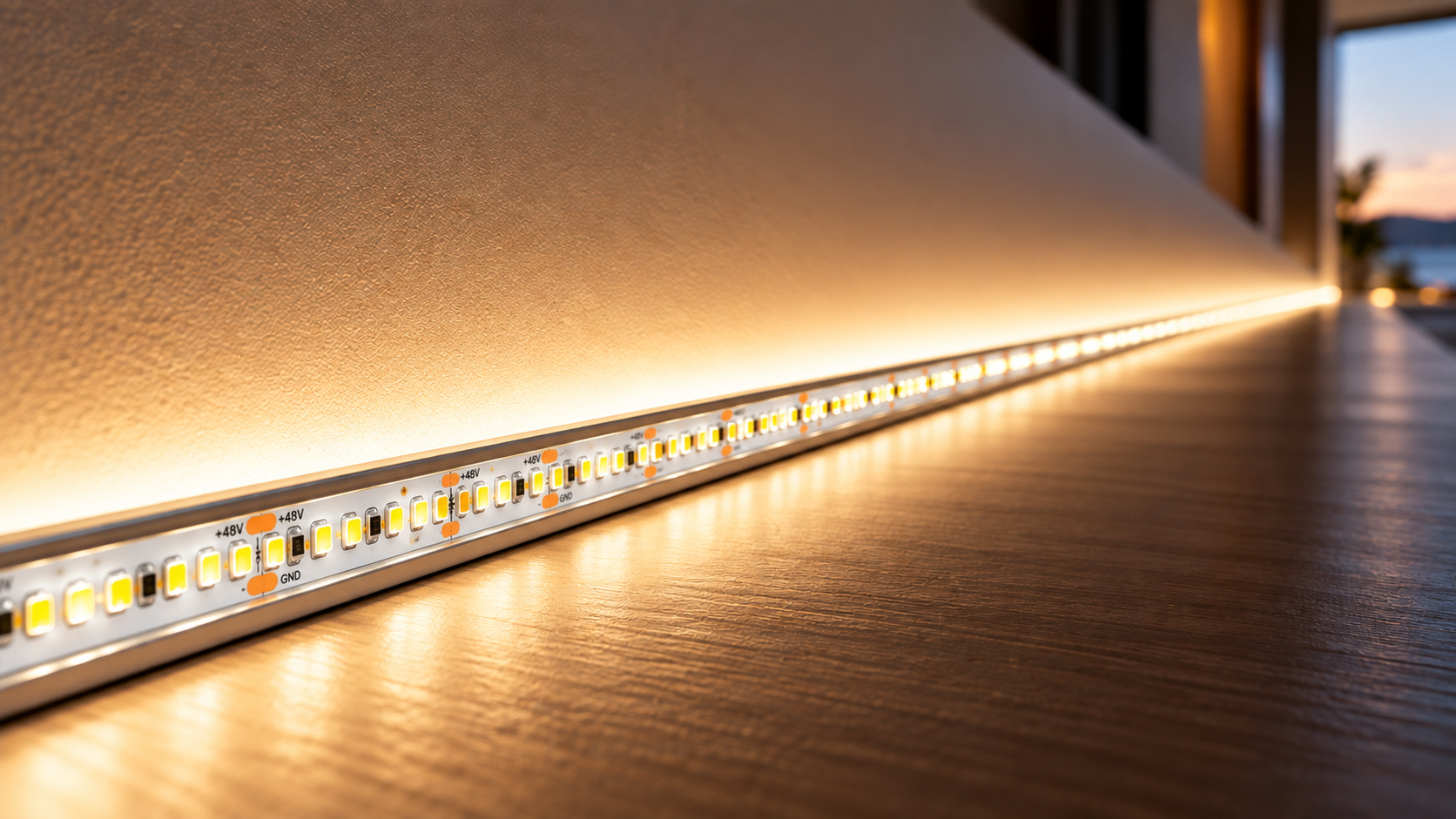
In short: at equal power, a 48V LED strip draws a quarter of the current of a 12V strip and half that of a 24V strip. Less current through the copper tracks means far less voltage drop. That is why the LEDCO SL120/48V can be installed in continuous runs of up to 30 metres from a single-end feed, with uniform light output from the first metre to the last.
What is voltage drop in an LED strip?
Voltage drop is the loss of voltage that occurs along the flexible printed circuit board (FPCB) of an LED strip. The copper tracks that carry power to the LEDs have electrical resistance. The longer the run and the higher the current, the lower the voltage available to the LEDs as you move away from the feed point.
The effect is visible to the naked eye, and it always shows up the same way:
– progressive loss of brightness towards the far end of the run;
– colour shift, with the end of the run drifting warmer or losing saturation;
– visible non-uniformity in continuous linear installations such as coves, coffers and exposed profiles.
In professional projects this is not an acceptable defect. A cove that gradually dims along a 25-metre corridor undermines the perception of the entire space. LEDs fed below their nominal voltage are also operating outside their design conditions.
What causes voltage drop
Voltage drop along a strip depends on three factors:
– the current flowing through the tracks, which in turn depends on power and voltage;
– the resistance of the tracks, i.e. the copper weight and track width of the PCB;
– the length of the run fed from a single point.
Of the three, current is the one the specifier can influence most effectively. This is where supply voltage comes in.
Why voltage drop falls at 48V: compared with 12V and 24V
The relationship follows directly from Ohm’s law applied to power: I = P / V. At equal power, doubling the voltage halves the current.
Take a 30-metre run of strip rated at 8 W/m, i.e. a 240 W load, and calculate the current at the feed point at the three most common supply voltages:
– 12V strip: 240 W / 12V = 20 A. Relative voltage drop: 16 times that of the 48V strip.
– 24V strip: 240 W / 24V = 10 A. Relative voltage drop: 4 times that of the 48V strip.
– 48V strip: 240 W / 48V = 5 A. Relative voltage drop: reference value (1×).
The comparison assumes equal power and identical copper tracks. The last figure in each line is the one that matters to the designer. Absolute voltage drop (ΔV = I × R) is proportional to current. What matters to the LED, however, is the drop as a percentage of nominal voltage. Moving from 24V to 48V:
– current halves, so the absolute drop halves;
– nominal voltage doubles, so that same drop carries half the weight in percentage terms.
The result: at 48V the relative voltage drop is a quarter of that at 24V, and a sixteenth of that at 12V, for the same power and the same copper tracks.
What this means in practice
With 12V and 24V strips, runs are typically limited to 5 or 10 metres per feed. Beyond that you need intermediate power injection points, double-end feeding or parallel feeder cables.
At 48V the picture changes. The SL120/48V is designed for 30 continuous metres from a single-end feed, with no intermediate injection points.
There is a secondary benefit too. Lower current means smaller cable cross-sectional area for the same distance between driver and strip. This is relevant when the driver sits in a remote plant room, riser or ceiling void, some way from the lit line.
SL120/48V: technical specification
The SL120/48V – 48V LED Strip 30 m is part of the LEDCO range of professional LED strips. Key data:
– Product code: SL120/48V
– Supply voltage: 48V DC
– Power: 8 W/m
– LED density: 120 LEDs/m
– Colour temperatures: 2700K, 3000K, 4000K, 6000K
– Colour rendering: CRI 90+
– Ingress protection: IP20 and IP68
– Cut increment: 100 mm
– Maximum run per feed: 30 m, single-end feed
Why these values matter in a specification
120 LEDs/m delivers continuous output with no visible dotting, even in profiles with a diffuser mounted close to the source. This is a fundamental requirement for exposed lines of light.
CRI 90+ is the threshold required wherever colour rendering is part of the brief: retail, hospitality, showrooms and exhibition spaces.
Four colour temperatures cover the full application range. They run from 2700K for warm, residential-style settings to 6000K for technical and task environments. 3000K and 4000K remain the benchmark choices for hospitality and offices.
8 W/m is a power rating calibrated for accent and ambient lighting over long distances. The total load stays manageable even at 30 metres: 240 W on a single driver.
A 100 mm cut increment lets the run be trimmed to actual site dimensions with good precision.
IP20 and IP68 versions mean the same product can be specified for dry interiors as well as for exterior, damp or submersible locations.
Uniformity: the same light from the first metre to the last
Uniformity is the benefit the client actually sees. Everything else is for the designer and the installer.
On a continuous 30-metre run, a low-voltage strip fed from one end would show a perceptible difference in brightness between start and finish. With the SL120/48V the available voltage remains stable along the entire run. The result:
– consistent luminous output over the full length;
– consistent colour temperature, with no colour drift towards the end of the run;
– no visible joints caused by intermediate feeds.
For architectural installations, this means lines of light can be designed as genuinely continuous elements: a perimeter cove, a slot of light in the ceiling, a profile running the full length of a façade. The space no longer has to be broken into 5- or 10-metre sections.
On site: fewer feeds, less cabling, faster installation
For the electrical contractor, the difference between 12V/24V and 48V translates into labour hours and components saved.
Fewer feed points. A 30-metre run at 24V typically needs three injection points, each with its own cable, joints and routing. At 48V it needs one.
Less concealed cabling. Every intermediate feed is another cable to pull through the ceiling void, plasterboard or profile. Eliminating them simplifies cable routes and reduces potential points of failure.
Centralised driver location. With a single feed per run, the driver can be installed in one accessible enclosure or plant space. This makes future maintenance much easier.
Fewer solder joints and connectors. Every connection is a potential weak point, particularly in IP68 installations. Fewer joints mean a more reliable installation over its service life.
Simpler design documentation. The wiring schematic comes down to one run, one driver, one feed. The bill of quantities and the project documentation benefit too.
How to size the driver for the SL120/48V
Good practice is to load the driver to no more than 80% of its rated output. This headroom protects driver lifetime and thermal stability, and avoids overload at inrush.
At 8 W/m, here is how the SL120/48V pairs with the LEDCO 48V driver range:
– Run up to 10 m (up to 80 W): TR48100 driver (IP20) or TR48100/67 (IP67)
– Run up to 20 m (up to 160 W): TR48200 driver (IP20) or TR48200/67 (IP67)
– Run up to 30 m (up to 240 W): TR48360 driver (IP20) or TR48300/67 (IP67)
IP20 or IP67? The TR48100, TR48200 and TR48360 drivers are IP20, for dry interior locations or protected technical enclosures. The TR48100/67, TR48200/67 and TR48300/67 are IP67, for exterior or damp locations, paired with the IP68 version of the SL120/48V.
Cable length between driver and strip. A 48V strip is far more tolerant, but the cable between driver and the start of the strip still needs to be sized correctly. The further away the driver, the larger the conductor cross-section required. At 48V, however, the reduced current allows smaller cross-sections than the same distances would demand at 12V or 24V.
Applications: where a 30-metre 48V LED strip makes the difference
The SL120/48V comes into its own on any project where linear light must cover significant distances without interruption.
Retail and large-format stores. Perimeter lighting to shelving and counters, ceiling slots along aisles and shopping arcades. CRI 90+ renders merchandise in its true colours.
Hospitality. Hotel corridors, lobby coves, backlighting for bars and reception desks. At 2700K and 3000K, warm and uniform light runs the full length of the space.
Offices and corporate workplaces. Continuous ceiling lines in open-plan areas and meeting rooms, accent lighting along walls and circulation routes. 4000K is the reference for working environments.
Architecture and façades. With the IP68 version and IP67 drivers, the strip can trace string courses, cornices, balustrades and exterior architectural details in a single continuous line.
Museums and exhibition spaces. Display cases, niches and visitor routes, where uniformity and colour rendering are non-negotiable.
Technical and industrial environments. 6000K meets the needs of laboratories, technical areas and production spaces, where neutral-to-cool light and long runs call for minimal electrical infrastructure.
Frequently asked questions about 48V LED strips
What is the maximum run length for a 48V LED strip from a single feed?
It depends on the product. The LEDCO SL120/48V is designed for runs of up to 30 metres from a single-end feed, with no perceptible voltage drop.
Why does a 48V strip have less voltage drop than a 24V strip?
At equal power, a 48V strip draws half the current of a 24V strip. Absolute voltage drop halves and, against a nominal voltage twice as high, it carries a quarter of the weight in percentage terms.
What driver output do I need for 30 metres of SL120/48V?
At 8 W/m, 30 metres draws 240 W. Allowing 20% headroom on the driver rating, the recommended pairings are the TR48360 (IP20) or the TR48300/67 (IP67).
Can the SL120/48V be cut to length?
Yes, at 100 mm cut increments, so the run can be matched to the project dimensions.
Can the SL120/48V be installed outdoors?
Yes, in the IP68 version, paired with the IP67 drivers TR48100/67, TR48200/67 or TR48300/67.
Is a 48V strip compatible with a 24V driver?
No. A 48V LED strip must be powered exclusively by a 48V DC driver. Connecting it to a driver at a different voltage will compromise its operation.
Specify the SL120/48V on your next project
If you are designing continuous lines of light over long distances, the SL120/48V cuts down feeds, cabling and critical points in the installation. And it delivers uniform light from the first metre to the last.
→ View the product page: SL120/48V – 48V LED Strip 30 m
→ Have a project to size? The LEDCO technical team is on hand to help you select the right strip, driver and control system. Contact the technical team