
When specifying a driver or power supply for a professional lighting installation, the insulation class is always listed among the technical data. It is a specification that directly affects installation method, wiring practice and the electrical safety of the system — yet it is often taken for granted or given little attention during the design stage. Understanding the difference between Class I and Class II can make a tangible difference on site.
What insulation class means
Insulation class indicates the level of electrical protection an appliance provides against the risk of electric shock, and defines how the appliance manages a potential failure of its internal insulation. In other words: what happens if, due to a manufacturing defect or accidental damage, mains voltage reaches the external metallic parts of the appliance?
The answer to this question changes fundamentally depending on the insulation class.
Class I: protection provided by the earth connection
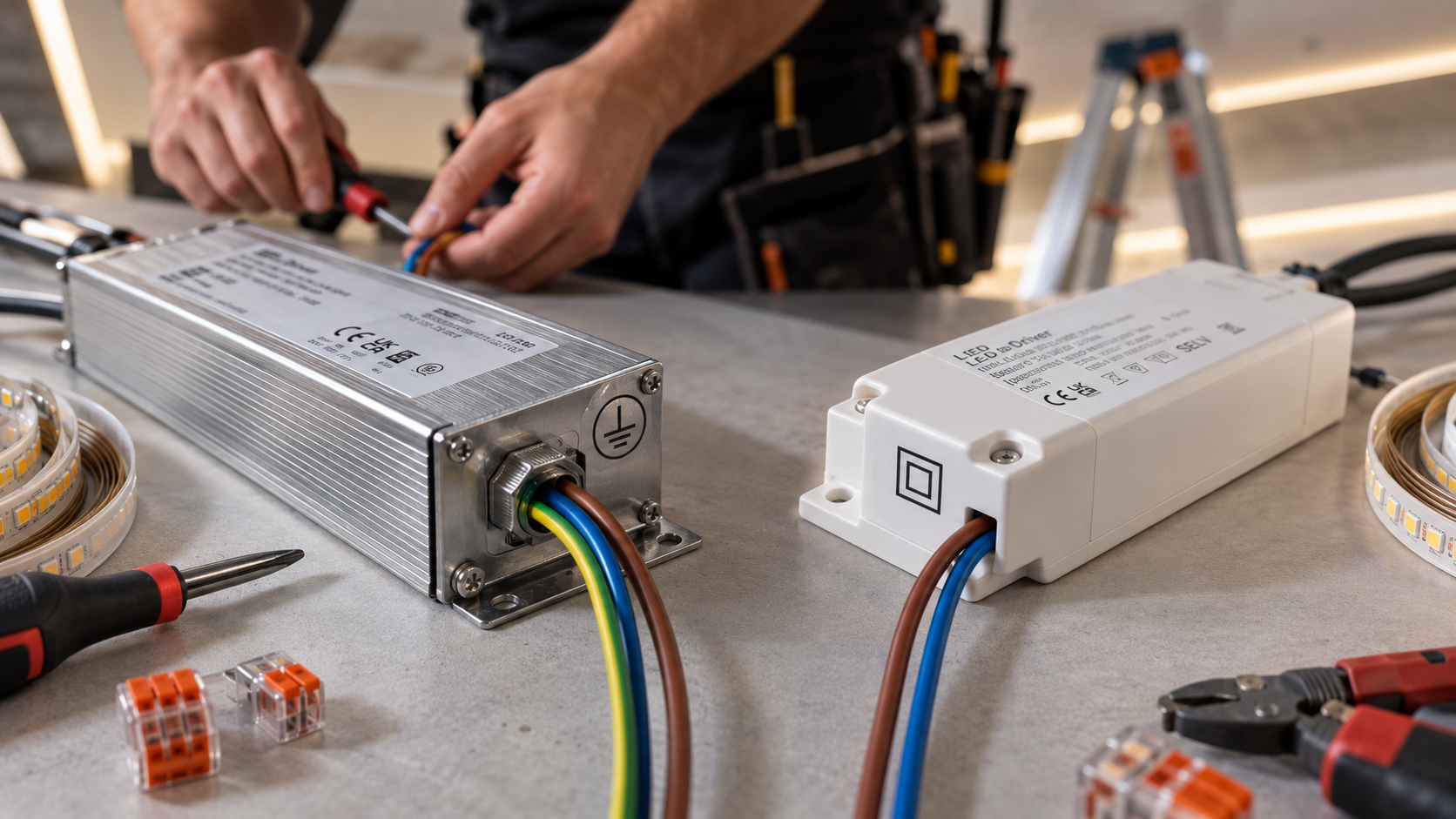
A Class I appliance is constructed with basic insulation between the live parts and the accessible metallic parts. Protection against indirect contact — that is, against the risk of touching a metallic part that has accidentally become live — relies on the protective earth (PE) conductor: in the event of a fault, current flows to earth via the protective conductor (the green-and-yellow wire), triggering the protective device (RCD or MCB) and breaking the circuit.
For this system to function correctly, the earthing installation must be present, effective and properly connected to the appliance. The installer must verify the continuity of the protective conductor and its connection to the installation’s earth terminal.
Class II: double insulation, no earth connection required
A Class II appliance — identifiable by the double-square symbol □□ on the rating plate — is constructed with double insulation: in addition to the basic insulation between the live parts and the metallic parts, a supplementary layer of insulation (or an equivalent reinforced insulation) is provided, ensuring protection even in the event of failure of the primary insulation layer.
The result is that, even if the main insulation fails, the external metallic parts of the appliance never reach a hazardous voltage. It is therefore not necessary to connect the appliance to the protective earth: safety is intrinsic to the construction of the appliance itself, independent of the quality or availability of the earthing installation.
Why Class II simplifies installation in residential and commercial environments
In residential, retail, office and hospitality environments, Class II offers significant practical advantages for the installer.
No protective conductor to manage. Wiring is simplified: there is no requirement to run an earth wire to the point of installation, reducing cable quantity and installation time — particularly in exposed installations or in positions that are difficult to access.
Greater positioning flexibility. In many contexts — already-finished suspended ceilings, surface-mounted profiles, installations on non-metallic substrates — the continuity of the protective earth conductor is not always guaranteed or easily verifiable. With a Class II appliance, this issue does not arise.
Compatibility with existing installations. In the refurbishment of historic buildings, or in contexts where the earthing installation is absent or non-compliant, Class II allows luminaires and drivers to be installed safely without the need to intervene on the main electrical installation.
When to specify Class I and when to specify Class II
Class I remains the standard choice in industrial environments, where earthing installations are always present and regularly verified, and where components are typically of higher power rating. In these settings, the double-insulation construction of Class II adds no significant advantage over a well-executed earthing system.
Class II is the preferred — and often more practical — specification in all residential and commercial contexts: housing, retail, hospitality, offices and contract spaces. Wherever installation simplicity, positioning flexibility and independence from the earthing installation are relevant requirements, Class II is the more appropriate choice.
Have a question about which insulation class best suits your next project?
Get in touch: our team is on hand for a dedicated technical consultation.