
Specifying the right luminaire is only half the work. The other half is control: how the light will be dimmed, who operates it, and how scalable the system needs to be. Three protocols dominate the professional lighting market — RF, 1-10V and DALI — and the choice between them is rarely straightforward. This practical guide helps you find your way.
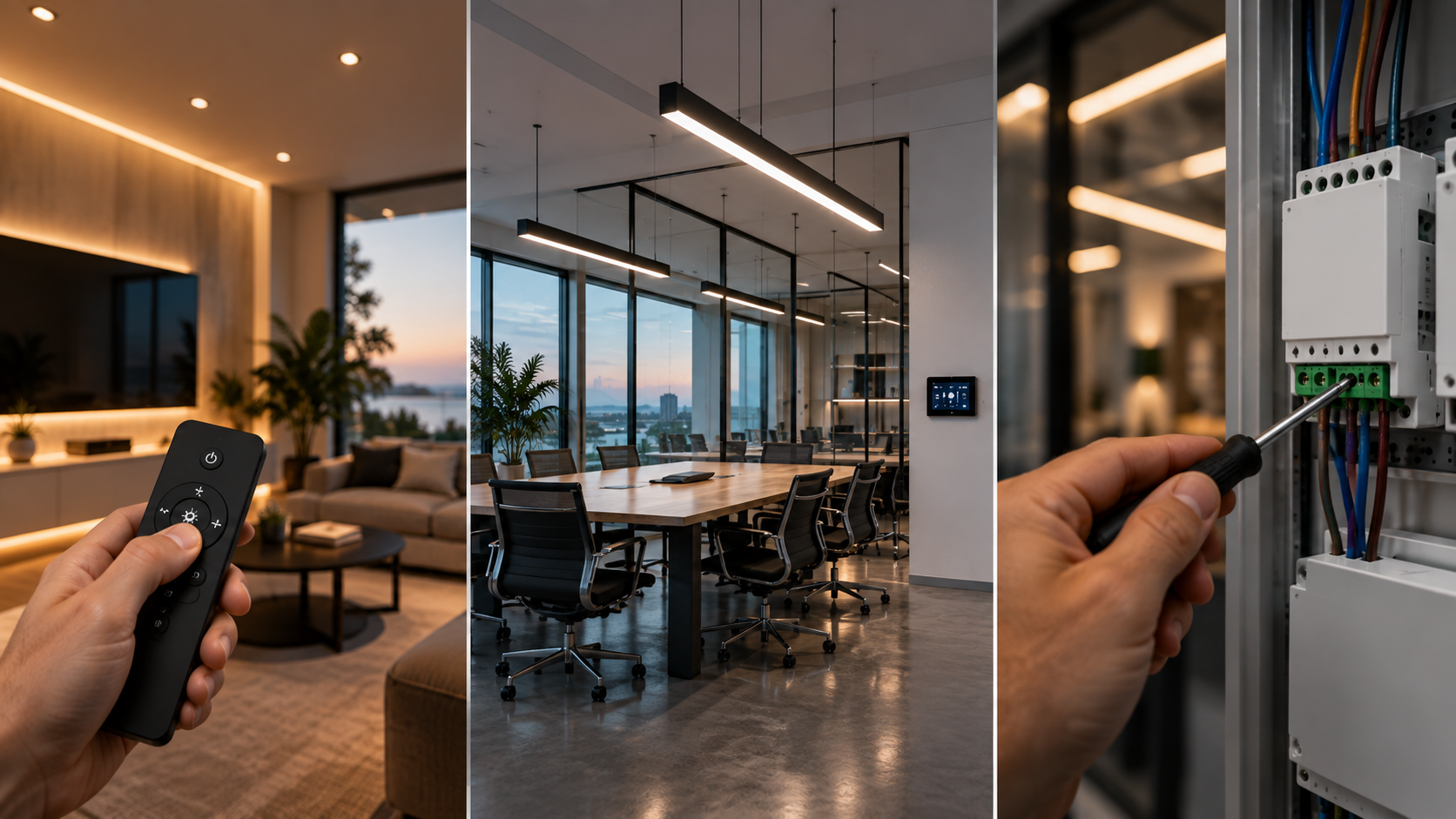
RF (Radio Frequency): wireless freedom
RF control works via radio signal: a wireless remote or wall panel communicates directly with compatible drivers, with no dedicated signal cabling required.
Range is the system’s primary limitation: architectural obstacles and electromagnetic interference can compromise signal reliability. Control is zone-based — all drivers in the same zone respond together — and integration with BMS or KNX platforms is difficult or not feasible. On the other hand, no additional signal cables need to be routed: installation is fast and requires no building work.
When to specify it: small-scale retail, restaurants, high-end residential projects where opening walls or ceilings is not an option, or any retrofit scenario where running new cables is impractical.
1-10V: reliable analogue dimming
The 1-10V protocol is an analogue standard that has been established for decades. A low-voltage signal cable — ranging from 1 to 10 volts — controls the driver’s dimming level: 1V corresponds to minimum output, 10V to maximum.
Simplicity is the protocol’s defining advantage: it is compatible with virtually all professional drivers, signal cabling is cost-effective, and installation requires no software commissioning. The limitation is structural: all drivers sharing the same signal cable dim together, with no individual addressability. There is no bidirectional communication — the driver sends no data back to the system — and scalability for complex installations is limited.
When to specify it: open-plan offices, showrooms, and contract spaces where zone-level control is sufficient and individual point-by-point programming is not required.
LEDCO’s 1-10V dimmers are fully compatible with our driver range, ensuring certified compatibility and smooth, flicker-free dimming performance.
DALI and DALI-2: addressable digital control
DALI (Digital Addressable Lighting Interface) is the digital protocol designed for advanced professional lighting installations. Each driver is assigned a unique address, enabling independent control of every single luminaire, the creation of lighting scenes, time-based sequences, and real-time feedback on system status.
DALI-2, the updated version of the standard, introduces bidirectional communication: drivers actively communicate with the control system, reporting faults, operating hours and actual light output. The result is an installation that can be monitored and diagnosed remotely — a level of control no other protocol can match.
The cost of this flexibility is complexity: the system requires a dedicated 2-wire bus, a more involved commissioning process, and DALI-compatible drivers at a higher unit cost than analogue alternatives.
When to specify it: hotels, museums, corporate headquarters, large-scale retail — any project requiring advanced automation, certifiable energy performance, and integration with building automation systems (BMS, KNX).
LEDCO’s DALI-2 drivers — models TR24150/D (150W) and TR24200/D (200W) — are DALI-2 certified and fully compatible with the leading control systems on the market. Bidirectional communication enables real-time monitoring of driver status, keeping your installation always under control.
Which protocol should you specify?
There is no universally superior protocol: the right choice depends on the type of installation, the budget, the level of integration required, and the feasibility of routing dedicated cabling.
RF is the right solution for retrofit projects or spaces where cables cannot be concealed. The 1-10V protocol is the most practical choice for linear installations with zone-based control. DALI-2 is the correct answer whenever the project calls for granular control, automation, and long-term scalability.
Not sure which control system best suits your next project?
Get in touch: our technical team is available for dedicated consultancy.