
Anyone who works with linear lighting knows the problem well: an LED strip installed in full view, without a profile or diffuser screen, reveals dot visibility — that sequence of distinct luminous points, one per chip, that makes the light output discontinuous and aesthetically poor. For years, the standard solution has been to add an opal diffuser screen to blend the light and conceal the LEDs. SOB (Silicon on Board) technology addresses this at source, eliminating dot visibility before it ever becomes an issue.
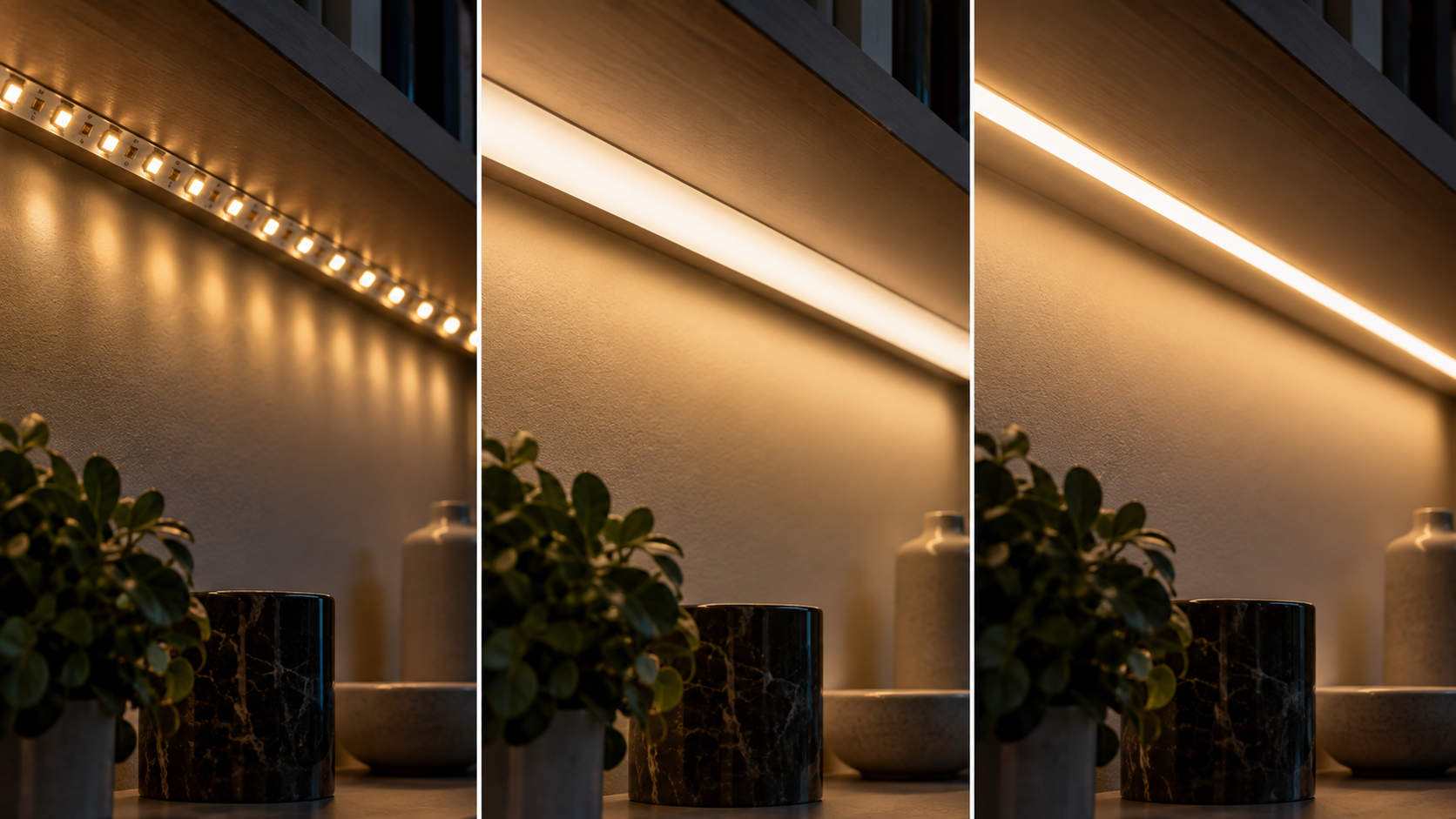
How a traditional LED strip works
In conventional LED strips — SMD (Surface Mounted Device) technology — individual LED chips are mounted onto the flexible printed circuit at fixed intervals. Each chip emits light as a point source: viewed at close range, or installed on a reflective surface, the individual luminous points are clearly visible. Higher LED density per metre reduces dot visibility, but never eliminates it entirely — and at low dimming levels it becomes even more pronounced.
The traditional solution is to interpose a diffuser screen — opal, satin or micro-prismatic — between the LEDs and the observer. The screen blends the output of the individual chips and returns a uniform line of light. It works, but it adds a layer to the profile assembly, reduces the transmitted luminous flux and limits installation flexibility.
The SOB solution: silicone resin as an optical element
SOB (Silicon on Board) is a construction technology in which LED chips are arranged in a continuous line directly on the flexible printed circuit, encased in a single continuous layer of silicone resin applied along the full length of the strip.
This layer is not simply mechanical or environmental protection: it is an active optical element. The silicone resin has light-diffusing properties that blend and distribute the luminous flux of the individual chips before it reaches the observer. The result is a continuous, uniform line of light, free from any visible discontinuity — without the addition of any external component.
In short: the diffuser screen is no longer required, because diffusion occurs within the resin layer itself.
Why silicone and not other materials
The choice of silicone resin is deliberate. Silicone has optical and physical characteristics that make it particularly well suited to this application: it is transparent, flexible, resistant to the elevated temperatures generated by the LED chips, dimensionally stable over time and compatible with high protection ratings. Its flexibility is critical: it allows the strip to bend over curved surfaces without the layer cracking or delaminating, preserving the diffusing properties intact.
In IP65 and IP68 variants, the silicone layer also functions as environmental protection, making the strip resistant to moisture, water ingress or full immersion, depending on the protection rating.
A concrete example: the LEDCO SLC220 IP65 LED Strip
LEDCO’s SLC220 IP65 LED Strip applies SOB technology to a configuration that operates directly at 220V AC without an external driver, with a single power point sufficient to feed runs of up to 50 metres. The integrated heat-dissipating silicone resin layer ensures a continuous, dot-free light output and makes any additional diffuser screen unnecessary, simplifying installation and reducing the number of components required.
Available in 2700K, 3000K, 4000K and 6000K, CRI90+, 3 Step MacAdam colour consistency: a strip that combines the optical quality of SOB technology with the installation simplicity of direct 220V AC connection.
When to specify an SOB strip
SOB technology is the right specification when the strip will be visible — without a profile, or within a clear-cover profile — and light output quality is a project requirement. Typical applications include exposed architectural lighting, perimeter coves, installations on curved surfaces, and retail or hospitality environments where light continuity is integral to the aesthetic result.
Where the strip is concealed within a profile fitted with a dedicated opal diffuser, the distinction between SMD and SOB is less critical: in that case, the profile itself performs the diffusion.
Would you like to find out more about SOB technology or discuss which strip best suits your project?
Get in touch: our team is on hand for a dedicated technical consultation.